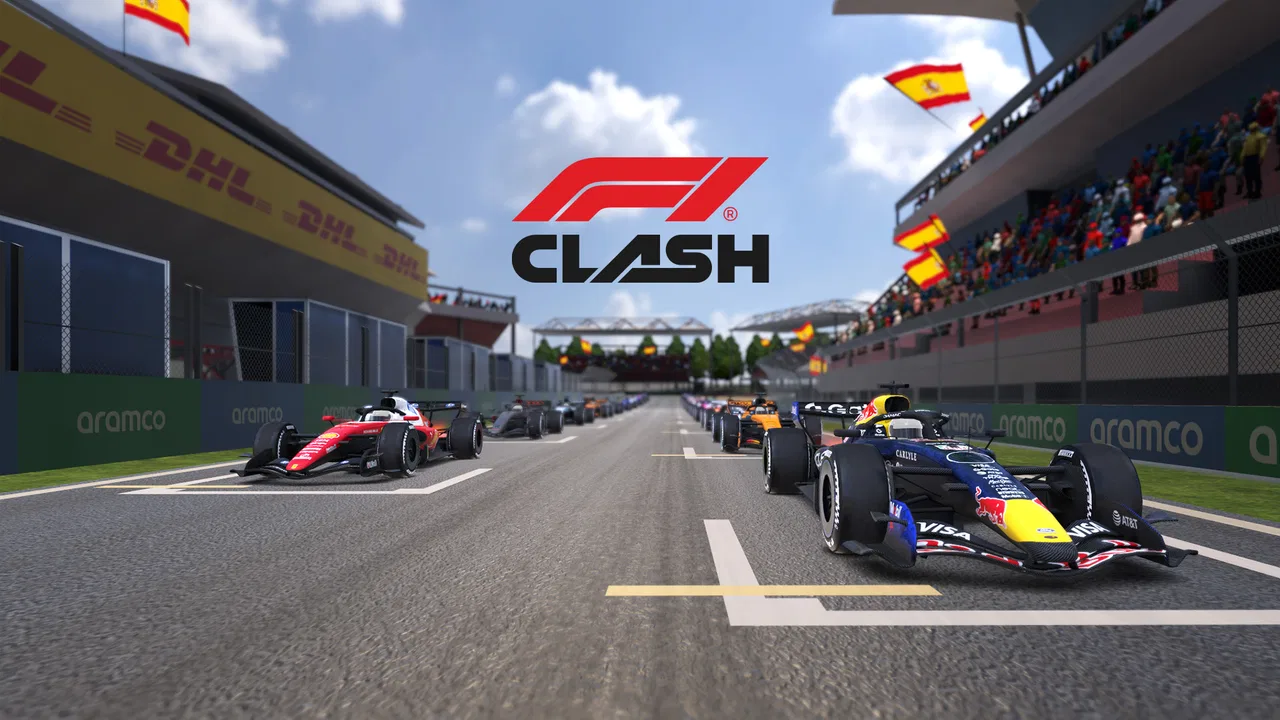
F1® Clash - Official 2026 Game
- 4.5
- Rating
- 10.00M
- Installs
- Free
- Price
 Analysis by App-foxy
What makes F1 Clash worth a closer look is not simply that it puts licensed-looking single-seater racing on a phone. Its central appeal is the way each race asks me to make strategic decisions while the cars are moving. I am not only trying to steer faster; I am choosing when to push, when to protect the car, and how to react to the other driver. That focus gives this free racing game a very different rhythm from an arcade racer built around constant swiping.
In my experience, this is best understood as a competitive racing game with a strategy layer rather than a traditional driving simulator. Hutch Games has built it for short multiplayer contests and long-term progression, so it suits players who enjoy making quick choices and then learning from the result. The game is available for free and carries an Everyone age rating, which makes it easy to try, although its optional purchases can become an important part of the experience for players who want to advance more quickly.
Why the strategic race is the real feature
The most important capability here is the ability to influence a race through timing and resource decisions instead of controlling every movement manually. That changes what “skill” means. A player who reacts calmly to changing race conditions can beat someone who simply taps aggressively, while a poor decision made early can leave a fast car with too little room to recover.
You May Also Like

 Blood Strike: 2.5 Anniversary
Blood Strike’s Loadouts Turn Every Drop Into a Tactical Gamble
A close look at Blood Strike’s custom loadouts: how fast access to signature weapons reshapes its battle royale rhythm, rewards preparation, and narrows the gap between fights.

 Pandora - Music & Podcasts
Pandora’s Music Is Easy to Start, but Harder to Recover
Pandora’s strength is its low-effort path from a seed to a station. Its weak spot is how much confidence it asks you to place in connection, setup, and quiet recovery.

 8 Ball Pool
 Is Built on Rivalries, Rematches, and Routine
A close look at the rivalries, rematches, shared routines, and unanswered safety questions that turn a quick pool match into a persistent mobile community.

 Samsung Music
’s Quiet Strength Is Playing What You Already Own
Its reach comes less from spectacle than from dependable access to a personal library. That simplicity is both the app’s strongest retention engine and its ceiling.

 AccuWeather: Weather Radar
AccuWeather Review: A Quick, Clear Forecast for Everyday Decisions
For everyday plans, the best forecast is the one you can understand quickly. AccuWeather makes rain timing, radar, and local conditions easy to act on, with a few trade-offs.

 Hill Climb Racing
Why Hill Climb Racing Still Turns Crashes Into One More Run
A tiny car, a bumpy hill and one more upgrade: Hill Climb Racing keeps resurfacing because its simple chaos makes every near-miss feel personal.
More From Our News Desk



This design also makes each event feel more personal than a simple time trial. In a time trial, I am mostly comparing my own line and speed against a clock. In F1 Clash, I am watching an opponent and deciding whether the current situation justifies taking a risk. The result is a compact contest where the important moment may be a tactical call rather than a dramatic corner.
The game’s racing category can sometimes create the expectation of direct steering, drifting, or detailed vehicle handling. That is not the main reason to install this one. Players who want to feel every turn through manual controls may find the experience less satisfying than a conventional mobile racer. Its strength is the decision-making around the race, especially for people who like competition but do not always have time for a long session.
That distinction matters before downloading. I would recommend it to a friend who enjoys motorsport strategy, quick competitive matches, and improving a plan over repeated attempts. I would not make it my first recommendation for someone searching for a realistic driving model, free exploration, or a purely offline racing experience.
What I actually do during a race
Once a race begins, my attention is split between the track, the rival car, and the consequences of each instruction. The temptation is to use every available opportunity to gain ground, but the better approach is usually to think one phase ahead. A move that looks strong immediately may create a problem later, particularly when the opponent responds in a way I did not expect.
This is where the multiplayer format earns its place. Racing against another player gives the decisions a sense of urgency that a predictable computer opponent may not provide. I cannot rely on the same pattern every time, because the other side may choose a different pace or respond differently to pressure. Even when the race is short, I feel encouraged to review what happened instead of treating the result as random.
A useful habit is to identify the point at which I lost control of the race rather than focusing only on the final position. Sometimes the error is an overly ambitious push. Sometimes I react too late and allow the opponent to dictate the pace. Looking at the race this way turns a defeat into a practical lesson: next time, I can change one decision instead of changing everything at once.
That learning loop is one of the game’s strongest qualities. It gives casual sessions a purpose, while more committed players can refine a repeatable approach. I especially like that the strategic layer makes small improvements visible. I may not become dramatically faster in a single evening, but I can become better at recognizing when a safe choice is more valuable than a flashy one.
A realistic way to fit it into a normal day
Imagine that I have ten minutes before leaving for work or while waiting for an appointment. A full console-style racing game would feel inconvenient, especially if I need a long uninterrupted session. Here, I can enter a competitive race, concentrate on a handful of meaningful decisions, and stop after the result without committing the rest of my day.
The same format works during a short break when I want something more engaging than a passive puzzle. I can play one race with a clear goal, such as testing a more conservative approach, then decide whether the result justifies another attempt. That makes the game easy to return to, because each session can answer a small question rather than requiring a large block of time.
There is a trade-off, though. Short races can encourage “just one more” behavior, particularly when a loss feels close. The competitive structure makes it easy to chase a better result instead of putting the phone away. I would set a personal stopping point before starting if I know I tend to keep playing after an unlucky outcome.
For a parent or commuter, this pick-up-and-play quality is more useful than a long career mode that demands a fixed schedule. For a player who wants to sit down for an extended driving session, it may feel too compressed. The same design that makes it convenient also limits the sense of immersion that comes from a longer, hands-on race.
How to get more from the strategy
My first practical tip is to avoid treating every race as a test of maximum aggression. The opponent is part of the problem, but so is the timing of the response. I get better results when I watch for moments where a decision changes the shape of the race, rather than spending every opportunity immediately. This is a small adjustment, but it prevents the common mistake of confusing activity with progress.
A second useful approach is to change one variable at a time when learning. If I alter my entire plan after a loss, I cannot tell which change helped. Instead, I might keep the same general approach and adjust only when I choose to push, or only how I respond to an opponent’s move. That makes the game feel less like guessing and more like building a personal racing method.
Third, I would not judge the game solely by the first few races. The strategic format takes a little time to appreciate because the controls are not the whole experience. At the beginning, a player may expect direct driving and wonder why the race feels less tactile. After several contests, the appeal becomes clearer: the satisfaction comes from reading the situation correctly and seeing that choice pay off.
It is also worth deciding in advance how much progression matters to you. The game is free to start, but optional purchases range from $0.49 to $334.99 per item. I would treat spending as a personal boundary rather than as a requirement for enjoying the basic concept. If competition makes you uncomfortable when progress appears linked to purchases, this is a point to consider before becoming heavily invested.
Where it differs from ordinary mobile racers
Compared with a conventional arcade racer, F1 Clash gives up some direct control in exchange for tactical pressure. An arcade game is often about memorizing corners, finding the ideal line, and reacting with precise taps or tilts. Here, the decisive skill is more managerial: I am trying to make the right call at the right moment while accounting for another competitor.
Compared with a serious driving simulator, the difference is even more obvious. A simulator is the better choice if I want detailed handling, realistic braking practice, or a strong connection between my fingers and the car’s movement. This game is better when I want the atmosphere of a competitive formula race without having to master a complete driving model.
It also has a different appeal from a casual endless racer. Endless games can be relaxing because the goal is often personal survival or a high score. F1 Clash keeps my attention on the opponent and the next tactical decision. That makes it more exciting for competitive players, but less peaceful for someone who wants a low-pressure way to pass time.
The multiplayer emphasis is therefore both its identity and its dividing line. Players who enjoy comparing decisions with other people will understand the attraction quickly. Players who prefer to compete only against their own best performance may find the pressure unnecessary, especially if a close loss affects their mood more than it motivates them.
The friction I noticed before recommending it
The biggest limitation is that the game’s strongest idea can also make it feel less like a racing game in the traditional sense. If I arrive expecting continuous manual driving, I may interpret the strategic controls as a lack of depth. The depth is present, but it is located in planning and timing rather than in steering technique.
The competitive structure can create another kind of friction: a result may depend on decisions made under pressure, and that can feel harsher than losing a solo race. I sometimes want a chance to experiment without worrying about the opponent’s response. This is not the right game for every mood, even if I enjoy it when I am ready for a focused contest.
Progression and optional purchases are also worth keeping in mind. Free access makes the initial decision easy, but the presence of purchases means I would avoid approaching the game with an assumption that every long-term path will feel equally fast or equally comfortable without spending. For me, the best experience comes from treating improvement as the main reward and purchases as something to consider carefully, not automatically.
Device compatibility is straightforward for supported players: the current version is 54.01.32933 and requires Android 10 or later. I would check that requirement before planning to play on an older phone. A game built around quick reactions and competitive timing is more enjoyable when the device feels comfortable and responsive, so a cramped or aging handset may reduce the appeal even when it technically runs the software.
Who will enjoy it most
The ideal player is someone who likes Formula-style competition but does not need a full simulation. If I enjoy studying why a race turned against me, making a different call next time, and competing in short sessions, this game offers a satisfying loop. It is also a good fit for players who like strategy games but want a more immediate visual setting than a board or card game.
It can work well for a newcomer to mobile racing because the concept is easy to understand: enter a race, observe the situation, make choices, and learn from the outcome. The deeper challenge comes later, when I realize that a quick reaction is not always the best reaction. That gradual shift from tapping to thinking gives the game more staying power than its simple entry point suggests.
Its audience is broad enough to explain the strong reception: it holds a 4.5 average from around 1.2 million ratings and has passed 10 million installs. Those figures do not replace personal taste, but they do indicate that the blend of racing presentation and multiplayer strategy has found a substantial audience.
The game is also suitable for players looking for an Everyone-rated title, although younger players may still need guidance around optional purchases and competitive play habits. I would explain that the game is free to begin but that in-app items are available, then set a clear spending rule before handing over a device.
My final recommendation
After spending time with it, I see F1 Clash as a focused strategy game wearing the shape of a racing game. Its best moments come when I resist the urge to act automatically, read the contest, and choose a plan that fits what is happening on the track. That is a more thoughtful experience than the store summary alone suggests, and it gives short races a useful sense of consequence.
I would recommend it to a friend who wants competitive motorsport in manageable sessions, especially if that friend enjoys improving through small tactical adjustments. I would steer a simulator fan toward a different option, and I would give the same warning to anyone who dislikes multiplayer pressure or does not want to think about optional purchases.
Hutch Games has made a clear choice: the race is not primarily about controlling every corner, but about deciding how to approach the contest. For me, that choice works when I want a quick, engaging challenge with room to learn. If you enjoy making the decision that changes a race, rather than merely driving through it, this is a free game worth trying.
FAQs for F1® Clash - Official 2026 Game
01What is F1 Clash and how does it work?
F1 Clash is a strategic racing game that allows players to manage their own Formula 1 team. You can compete in real-time 1v1 races against players worldwide. The game involves making strategic decisions like tire choices, pit stop timings, and driver management to outsmart your opponents and win races.
02Is F1 Clash free to play, and are there in-app purchases?
Yes, F1 Clash is free to download and play on both Android and iOS devices. However, it does offer in-app purchases that can enhance gameplay, such as acquiring premium items, upgrading cars, or unlocking new features faster. Players can enjoy the game without spending money, but purchases can provide a competitive edge.
03What are the system requirements for F1 Clash?
For Android devices, F1 Clash requires Android 5.0 and above, while iOS devices need iOS 10.0 or later. It is recommended to have a stable internet connection for optimal gameplay, as the game involves real-time multiplayer races. Ensure your device has adequate storage space for smooth installation and updates.
04Can I play F1 Clash offline?
No, F1 Clash requires an internet connection to play. The game features real-time multiplayer races, which necessitate a stable online connection. This connectivity allows players to compete globally, check leaderboards, and participate in live events, enhancing the overall gaming experience.
05How does the player progression work in F1 Clash?
Player progression in F1 Clash involves earning experience points and in-game currency through races and events. As you progress, you can unlock new tracks, upgrade cars, and improve driver skills. Strategic management of resources and decision-making during races are crucial for advancing through the ranks and dominating the leaderboards.
Pros
- Engaging real-time multiplayer races.
- Authentic F1 team and driver licenses.
- Strategic gameplay with pit stops.
- Frequent updates and new content.
- Smooth graphics and animations.
Cons
- Requires constant internet connection.
- In-app purchases can be costly.
- Occasional matchmaking issues.
- Battery drains quickly during play.
- Some features locked for free users.

F1® Clash - Official 2026 Game
Gallery